Logistics Glossary — Freight Terms Explained.
The terms on your quote, your bill of lading and your customs entry, defined in plain language and linked to how each one works on a China–Jordan shipment.
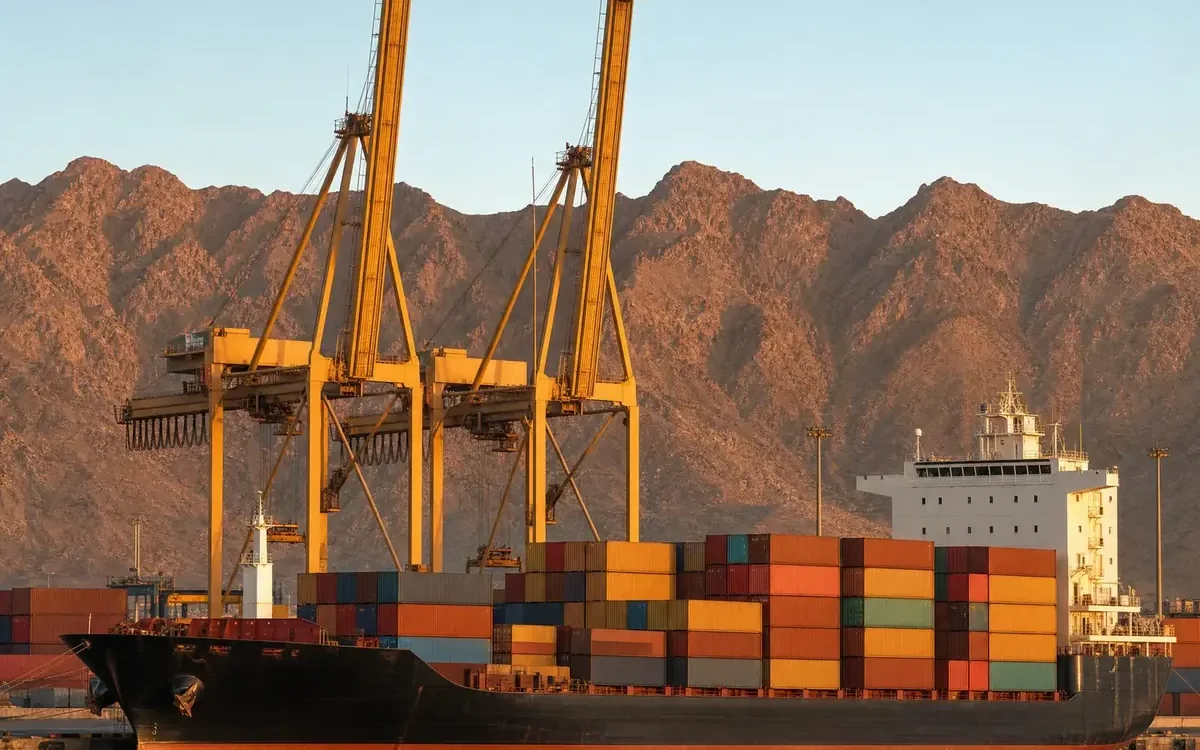
Freight has a working vocabulary that quotes, booking confirmations and customs entries use without explanation. Most of it is short — FCL, CBM, THC, HS — and most of the expensive misunderstandings in a shipment trace back to one of those abbreviations read the wrong way.
The terms below are grouped by where you meet them: at the container, at the port, in the air, on the road, at customs, in the contract and in the warehouse. Each definition is written for a Jordanian importer or exporter, and where MASA handles the thing itself, the entry links to the page that shows how.
Containers and Sea Freight
The Box and the Vessel.
Sea freight is priced and planned around the container. These are the words that describe it.
- FCL — Full Container LoadOne shipper's cargo fills a container that is sealed at origin and opened only at destination. The rate is per box rather than per cubic metre, so a well-packed container is the lowest sea freight cost per unit of cargo. How MASA books FCL
- LCL — Less than Container LoadYour cargo shares a container with other shippers' goods. It is consolidated at a container freight station at origin and separated again at destination, and it is charged on volume in CBM rather than per box. LCL from China to Jordan
- TEU, FEU and High CubeContainer sizes. A TEU is a standard twenty-foot box and an FEU a forty-foot one; a 40' high cube is about a foot taller than a standard forty. Vessel and port capacity is counted in TEUs, but your quote is for the box you actually ship.
- Reefer ContainerA container with its own refrigeration unit, running at a set point agreed before loading and plugged in on the vessel and at the terminal. Used for temperature-sensitive cargo in both directions. Reefer shipments with MASA
- Open Top and Flat RackContainers for cargo that does not fit a standard box: an open top for over-height pieces loaded by crane from above, a flat rack for over-width or over-length pieces that sit on a base and are lashed to it. Out-of-gauge cargo
- OOG — Out of GaugeCargo whose dimensions exceed the internal limits of a standard container, so it needs an open top, a flat rack or break-bulk handling, and usually attracts a surcharge for the vessel slots it blocks. Project cargo
- Break BulkCargo shipped as individual pieces — crates, machinery, steel, bagged goods — lifted on and off the vessel without a container. Break bulk with MASA
- RoRo — Roll-on/Roll-offA vessel with ramps that wheeled cargo is driven onto and off: cars, trucks, buses, trailers and tracked machinery carried on trailers. RoRo shipping
- TransshipmentThe container is moved from one vessel to another at an intermediate port on the way. A direct service avoids it; a transshipment service is often cheaper or more frequent but adds handling and a connection that can be missed.
Bookings, Timing and Port Charges
The Clock Every Shipment Runs On.
Most avoidable charges in sea freight are time charges. These terms are the clock.
- Cut-offThe deadline at the port of loading after which cargo or documents are not accepted for a sailing. There is a cargo cut-off, a documentation cut-off and usually a separate VGM cut-off; miss any one and the container rolls to the next vessel.
- VGM — Verified Gross MassThe declared, verified weight of a packed container, required under the SOLAS convention before it can be loaded on a vessel. Without a VGM the container is not loaded.
- ETD and ETAEstimated time of departure and estimated time of arrival. Both come from the carrier's schedule and move with weather, port congestion and vessel rotation; they are estimates, not contractual delivery dates.
- RolloverA booked container that is not loaded on the intended vessel — for a missed cut-off, an overbooked sailing or a customs hold — and is carried on a later one.
- Free TimeThe days a container may stay inside the port, or be kept outside it, before the carrier or the terminal starts charging. It is set by the carrier and the port and confirmed per booking.
- DemurrageThe charge for a laden container still inside the port after its free time has run out — usually because clearance or collection is late. Clearing before the clock runs
- DetentionThe charge for a container kept outside the port beyond its free time — unpacked slowly, or returned late to the depot the carrier nominates. Demurrage runs inside the port gate; detention runs outside it.
- THC — Terminal Handling ChargeThe port terminal's fee for moving the container between the quay, the vessel and the yard. Charged at origin and at destination, and usually shown as a separate line from ocean freight.
- CFS — Container Freight StationThe warehouse at a port where LCL cargo is consolidated into containers for export and deconsolidated again on import. CFS charges appear on LCL quotes at both ends.
Air Freight
Weight, Volume and the Waybill.
Air freight is sold by weight — but not always the weight on the scale.
- Chargeable WeightThe figure the airline actually bills: the greater of the shipment's actual weight and its volumetric weight. Light, bulky cargo is charged on volume; dense cargo on the scale. How air freight is priced
- Volumetric WeightVolume converted into a weight equivalent using a divisor — 6,000 cubic centimetres per kilogram is the IATA standard for air cargo, and express couriers commonly use 5,000. The CBM calculator on this site does the conversion. CBM calculator
- AWB — Air WaybillThe air freight transport document, issued by the airline as a master air waybill (MAWB) or by the forwarder to each shipper inside a consolidation as a house air waybill (HAWB). It is a receipt and a contract of carriage, not a document of title.
- Consolidation (Air)Several shippers' cargo grouped by a forwarder under one master air waybill to reach a better rate band, each shipper holding its own house air waybill.
- ULD — Unit Load DeviceThe aircraft pallets and containers that cargo is built onto before loading. Cargo that fits the ULD contour flies on passenger and freighter aircraft alike; oversized pieces may be limited to freighters.
- Airport-to-Airport vs Door-to-DoorAirport-to-airport covers the flight only; pickup, export clearance, import clearance and delivery are separate. Door-to-door bundles them under one party and one invoice.
Road, Transit and Borders
Trucks, Crossings and Transit Papers.
From Aqaba to Baghdad or Riyadh, the last leg is a truck and a border. These are its terms.
- FTL — Full Truck LoadOne shipper's cargo takes the whole trailer and moves without intermediate handling from loading to delivery. MASA moves road freight as FTL. Road freight with MASA
- LTL / GroupagePart-loads from several shippers sharing one truck, handled at hubs along the way — the road equivalent of LCL. MASA does not offer LTL; smaller consignments are quoted as LCL by sea. LCL by sea
- Customs TransitMoving goods through a country under customs control without clearing them for consumption there, against a transit declaration and a guarantee that is discharged when the goods exit at the far border. Transit to Iraq through Jordan
- Transit GuaranteeThe security lodged with customs to cover the duties on goods moving in transit, released once customs confirms the goods have left the country. China to Iraq via Aqaba
- Border CrossingThe customs post where a truck leaves one country and enters the next. On Jordan's transit routes: Karameh–Trebil into Iraq; Al-Omari and Durra into Saudi Arabia. Transit to Saudi Arabia
- Cargo ManifestThe list of every consignment on a vessel, aircraft or truck, presented to customs and the port. A manifest error is the usual reason a container is held before clearance even begins.
- Lowbed and Multi-Axle TrailersSpecialised trailers for heavy or tall pieces: a lowbed drops the deck to keep tall cargo under bridge heights; a multi-axle trailer spreads exceptional weight across more axles to stay within road limits. Between the port and the site
- Route SurveyA check of the road between the port and the site before an oversized move — bridges, overhead lines, turning radii and weight limits — to confirm the piece can physically get through.
- Cross TradeA shipment between two countries that never enters the forwarder's own country, arranged and controlled from a third. MASA coordinates cross-trade moves from Jordan. Cross trade
Customs and Documents
The Paper the Border Reads.
Customs clears documents before it clears cargo. Each of these is a document — or a field on one — that decides how fast.
- HS CodeThe Harmonized System tariff number that classifies goods for customs. The first six digits are international; national tariffs add further digits that set the duty rate and any permit requirement. The single most important field on a declaration. Customs clearance in Jordan
- Commercial InvoiceThe seller's invoice for the goods, stating buyer, seller, description, quantity, unit price, currency and the Incoterm. Customs value is assessed from it, so it has to match the packing list and the transport document exactly.
- Packing ListThe document that says what is inside each package — count, contents, dimensions and weights. It is what the freight station, the trucker and the customs inspector actually check the cargo against.
- Certificate of OriginA document certifying the country in which the goods were produced, issued by a chamber of commerce or authority in the exporting country. It decides whether a preferential duty rate applies.
- Customs DeclarationThe formal entry lodged with customs describing the goods, their value, origin and classification, on which duties and taxes are assessed. In Jordan, MASA's declarations are lodged through its sister company, a licensed customs broker. How MASA clears
- Customs BrokerA firm licensed by the customs authority to prepare and lodge declarations on an importer's behalf. A freight forwarder is not automatically a broker.
- Duties and TaxesThe customs duty set by the tariff line and the origin, plus sales tax and any excise or fees, assessed on the declared value. They fall due before the goods are released unless the goods are in transit or bonded.
- Customs InspectionA physical or documentary examination customs may order before release. It adds days and storage; a declaration that matches the documents and the cargo is the best protection against it.
- Shipping MarkThe identifying label on every package — usually a code, the destination and the piece number of the total — so cargo can be traced through a consolidation and matched to the packing list. Five things to settle with your supplier
- Conformity CertificateA certificate some product categories need before they can be imported, confirming the goods meet the destination country's standards. Whether it applies depends on the product, so it is checked before the order ships, not at the border.
Incoterms and Pricing
Who Pays, and Who Carries the Risk.
Three letters in the contract decide most of what a shipment costs you. The full guide is a page of its own; these are the entries you will meet most.
- IncotermsThe ICC's standard trade terms — three letters in the sales contract that allocate cost, risk and clearance between seller and buyer. The current edition is Incoterms 2020. Incoterms 2020 guide
- EXW — Ex WorksThe buyer takes over at the seller's door and arranges everything from there, including export clearance in the seller's country.
- FOB — Free On BoardThe seller delivers the goods on board the vessel at the port of loading, cleared for export; cost and risk pass to the buyer at that point. The term that appears most often on China–Jordan invoices.
- CIF — Cost, Insurance and FreightThe seller pays freight and minimum-cover insurance to the destination port, but risk passes to the buyer once the goods are on board at origin. Destination charges and import clearance stay with the buyer.
- DAP — Delivered at PlaceThe seller delivers to the named place at destination, not unloaded, with import clearance, duties and taxes remaining with the buyer.
- DDP — Delivered Duty PaidThe seller delivers cleared, with duties and taxes paid, to the named place. The only Incoterm under which the seller carries import clearance. DDP door-to-door with MASA
- Landed CostThe full cost of getting goods to your door: the goods, freight, insurance, port charges, duties, taxes, clearance and delivery. The figure that makes two quotes comparable.
- SurchargeA line added to the base freight for a specific cost — fuel, currency, peak season, security — usually identified by an acronym such as BAF or PSS. Ask for an all-in figure so nothing appears for the first time at destination.
- Proforma InvoiceThe seller's preliminary invoice, issued before the sale is confirmed, used to agree price, quantity and Incoterm and to obtain a freight quote. The commercial invoice replaces it once the order ships.
Warehousing and Sourcing
Between the Supplier and the Ship.
What happens to cargo before it is booked decides how cleanly it ships.
- Consolidation WarehouseA warehouse at origin that receives cargo from several suppliers and holds it until a container or an air shipment is built. MASA's own China warehouse does this for multi-supplier orders. MASA's China warehouse
- Cargo Ready DateThe date the supplier commits to having the goods packed and available for collection. Bookings, cut-offs and consolidation cycles are all planned from it.
- Supplier PickupCollection of cargo from the factory or the supplier's premises and delivery to the consolidation warehouse or the port, arranged by the forwarder.
- Loading SupervisionA check at the point of loading that the cargo matches the packing list in count and condition before the container is sealed, so that what leaves origin is what was ordered. Controlled loading
- Deconsolidation / DevanningUnpacking a container at destination — at a container freight station for LCL, or at the consignee's or the forwarder's warehouse for FCL — and sorting the cargo by consignee. Warehousing in Jordan
- Bonded WarehouseA warehouse under customs control where imported goods can be stored with duties suspended until they are released for the local market or re-exported.
- Export PackingPacking designed to survive the journey rather than the shelf: cartons on pallets, strapped and wrapped; crates for machinery; marks and moisture protection where the cargo needs them.
Common Questions
The Glossary, Answered.
What is the difference between FCL and LCL?
FCL is a whole container for one shipper, priced per box. LCL is space in a shared container, priced per cubic metre. Beyond a certain volume a full container costs less than the same cargo shipped as LCL; where that crossover falls depends on the route and on how the cargo packs, so ask for both rates when the volume is borderline.
How is CBM calculated?
Length × width × height of each package in metres, added up across the shipment. A carton measuring 0.6 m × 0.4 m × 0.5 m is 0.12 CBM. For air freight the same volume converts to a volumetric weight using the 1:6000 divisor. The CBM calculator on this site does both.
What is the difference between demurrage and detention?
Both are time charges on a container after its free time runs out. Demurrage applies while the container is still inside the port; detention applies once it has left the port and is not yet returned empty to the carrier's depot. A slow clearance causes demurrage; a slow unpacking causes detention.
Does DDP mean I pay nothing at destination?
Under DDP the seller delivers with duties and taxes paid to the named place. Unloading at your premises, and anything outside the agreed scope — storage caused by a customs hold, for example — can still be billed, so a DDP quote should state exactly what it includes.
What is chargeable weight in air freight?
The higher of the actual weight and the volumetric weight. Volumetric weight is the shipment's volume in cubic centimetres divided by 6,000 for air cargo, which means one cubic metre is charged as at least 167 kg however little it weighs. Light, bulky cargo is charged on volume; dense cargo on the scale.
Which of these terms do I need for a first shipment from China?
Four: the Incoterm on your supplier's proforma invoice, the HS code of your goods, the CBM of the packed cargo, and the cargo ready date. With those, a forwarder can quote sea or air and tell you what the border will ask for.
Read Next