Export from Jordan — Freight, Documentation and the Route Out.
MASA Logistics moves Jordanian cargo outbound to buyers worldwide. We collect from your facility, prepare the export documentation, and handle the port work by sea, by air or by road. One contract, one accountable team, and a clear split between what we control and what the destination country decides.
The Outbound Side
Exporting from Jordan Is Not Importing in Reverse.
Most of what is written about shipping in Jordan is written for the importer. The exporter's problem is a different one. You are the shipper, the obligations start at your own loading bay, and the rules that decide whether the cargo is admitted at the destination are written by another government.
When you import, the documents arrive from a supplier and your job is to check them. When you export, you issue them. The commercial invoice is yours, the packing list describes how you packed, and the goods description you write becomes the description a foreign customs officer classifies against. There is no supplier further back to carry the blame. That is why the export file is built carefully before the cargo leaves your yard.
The second difference is jurisdiction. Jordan decides what may leave and on what evidence. The buyer's country decides what may enter, at what duty, and against which certificates. Those two sets of rules are not coordinated with each other, and neither of them is negotiable by a freight forwarder. What a forwarder can do is establish what the destination asks for before your goods are packed, rather than after they are standing at a foreign border.
The third difference is money. An importer who gets a term wrong overpays. An exporter who gets a term wrong has usually already quoted a price to the buyer, signed it into a contract, and cannot reopen it. Costs at the far end — destination handling, clearance, duty, local tax, inland delivery — do not disappear because they were left out of the calculation. Somebody pays them, and the term you agreed decides who.
Documentation
The Documents an Export File Is Built From.
Three documents travel with almost every export: a commercial invoice, a packing list, and a transport document. A certificate of origin is commonly asked for as well, depending on the destination and the commodity. What sits beyond those four is decided by the importing country and by the commodity, not by us, and it is confirmed before you pack rather than after the cargo is standing at a border.
The first rule of an export file is that every document has to agree with every other one. The value on the invoice, the piece count and weights on the packing list, the marks on the cartons and the description on the transport document are all read together at the far end. A discrepancy between any two of them is a common reason a consignment stops moving, and it is the cheapest thing in the whole chain to fix before the cargo is sealed.
Beyond the core set, requirements belong to the destination. Depending on the country and the commodity, a buyer's authority may call for health, phytosanitary or veterinary certification, a conformity or inspection certificate, product registration, specific labelling in the local language, or certification and legalisation of the commercial documents before shipment. None of that is something MASA decides or can waive. What we do is confirm what the destination requires before you pack, so the paperwork is applied for while the goods are still in Jordan.
For a Jordanian export the certificate of origin is applied for in Jordan, before the cargo ships. The application is built from the same commercial invoice and packing list the rest of the file uses, which is one more reason to settle the goods description once and keep it consistent: a description that has already been checked does not have to be checked twice, and a description that changes between documents has to be explained.
Where a trade agreement applies between Jordan and the buyer's market, and the goods meet its rules of origin, the buyer may be able to claim a reduced duty. The claim needs proof in the exact form that agreement specifies. Ask which form the buyer's own authority accepts before you apply, because a certificate issued in the wrong form is not corrected at the far end. What the certificate proves, and when it changes the duty, is set out in full on our customs clearance page.
What a certificate of origin proves, and when it changes the duty
Two Borders
Export Clearance Out of Jordan, Import Clearance at the Far End.
Every export crosses two borders and faces two authorities. Jordan has to be satisfied that the goods may leave and that they are declared correctly. The importing country has to be satisfied that they may enter. The two decisions are separate, and passing one guarantees nothing about the other.
On the Jordanian side, the export declaration is made against the same figures printed on your invoice and packing list: description, quantity, weight, value and destination. MASA prepares the export documentation and handles the port or terminal work that follows it, so the documents the declaration is built from are checked against each other before the cargo leaves your yard. Where a commodity needs a permit or an approval before it may leave, that has to be in hand first, and it attaches to the exporter rather than to the forwarder.
At the far end, import clearance is normally the buyer's responsibility, because most trade terms hand over before the destination border. The buyer files in its own name, pays the duty and tax assessed there, and is bound by the classification the local authority applies. If you have quoted a delivered price that includes those steps, the position reverses entirely, and that is a much larger commitment than it looks like on a quotation.
Where a term does put destination clearance on you, MASA arranges the far-end work through the agent we appoint for that market. That agent works to our instructions, and MASA remains your counterparty throughout. What no forwarder can promise is the outcome. The examination, the valuation and the release are the importing authority's decisions, and it makes them after the cargo has already travelled. That is why the file is checked in Jordan, where a correction still costs a reissued document rather than a detained shipment.
Choosing the Mode
Sea, Air or Road for an Outbound Consignment.
Three things decide the mode for an outbound consignment: what the cargo weighs against what it measures, where the buyer is, and what the sales contract committed you to. Cost follows from those three, not the other way round. What you would prefer matters less than what the cargo and the contract allow, and a mode chosen before the contract is read is a mode that may have to be changed.
Sea freight carries weight and volume that air will not take sensibly, and it is the normal answer for a standing export programme sold to a buyer who can plan around a schedule. Air is bought when the cost of the goods waiting is higher than the cost of flying them: samples, replacement parts, launch stock, anything with a contractual delivery date attached. Air is charged on the greater of actual and volumetric weight, so bulky light cargo is expensive to fly.
Road serves the regional markets. For a buyer inside the region, trucking out of your facility is often a single movement rather than a chain of handovers, with no port stage at either end and no repacking between modes. It suits full and part truckloads, and it suits cargo that would otherwise wait for a sailing. The crossings themselves and their procedures are run by the authorities on each side, not by us.
The mode also changes the document set. A sea shipment moves on a bill of lading, an air shipment on an air waybill, and a road movement on the consignment note issued for that route. They are not interchangeable, and the buyer's bank may care which one it is where payment runs through documentary terms. Decide the mode before you promise a buyer a document you will not be able to produce.
Terms, From the Seller's Side
The Incoterm You Quote Is the Cost You Agreed to Carry.
An Incoterm is not a shipping preference. It is the part of your sales contract that fixes how far you carry the cost and where the risk leaves you. Exporters lose margin by quoting a term generously and pricing it as though it were a smaller one.
You are the party drafting the offer, so the term is something you write rather than something you receive. The named place and the edition of the rules belong in the quotation line itself, not in a later confirmation. An unqualified three-letter code is not a term either side can enforce, and by the time a buyer disputes it the cargo has usually moved. What each term shifts between seller and buyer is set out in full on our import guide.
The commercial mistake usually takes the same shape. A buyer asks for a delivered price, the seller adds a round figure to the ex-works price, and the quotation goes out. Then destination handling, clearance, duty, local tax and the final delivery arrive as real invoices, and the margin that was in the order has gone. Price the term you are quoting leg by leg before you send it, not after the buyer has accepted it.
DDP deserves particular care from a seller. It obliges you to deliver the goods cleared for import, with duty and tax paid, in a country whose customs system may not permit a foreign company to act as importer of record at all. Where it does not, the term has to be reworked or handled through a party that can act there. Settle that before the contract is signed, not after the cargo has already shipped.
Part Loads
When the Export Order Does Not Fill a Container.
Export orders rarely arrive in container-sized pieces. A first order for a new buyer, a restock, a trade-fair shipment or a sample run all move at volumes well under a full box, and paying for a whole container to carry them is not the only option.
A part load travels as shared container space alongside other consignments. How that space is rated and consolidated is set out in full on our LCL page. What matters on the export side is that the figure is taken from your cargo as it is packed, so a quote cannot be firmed up until the pallets exist and the cartons have been measured. Send estimates where that is all you have, and expect the number to move once the real dimensions arrive.
Sharing a container has consequences for packing. The cargo is consolidated with other shippers' goods at origin and separated again at destination, which means more handling than a sealed box receives and cargo stacked against yours that you did not choose. Palletise where the goods allow it, and mark every package so it can be identified without opening it. Pack for handling in transit, not for display at the point of sale. With fragile, high-value or strongly scented goods, a container of your own usually costs less than the damage it prevents.
Part loads also work at higher volumes. Where you ship regularly to the same market, several consignments can be planned onto one booking instead of moving separately, which is a different exercise from booking each order as it closes. The point at which a full container becomes the cheaper answer can arrive earlier than a first calculation suggests, particularly for dense cargo. We will tell you when your volume has crossed that line, including when the answer is less freight than you asked us to quote.
Routes Out
Aqaba, Queen Alia and Jordan's Land Crossings.
Jordan has one seaport, one main cargo airport and a set of land crossings. Every export leaves through one of them, and which one it is shapes the packing, the documents and the handling long before the cargo moves. Choosing the gateway is therefore part of the export decision, not a detail that follows it, and it is settled at the same time as the mode.
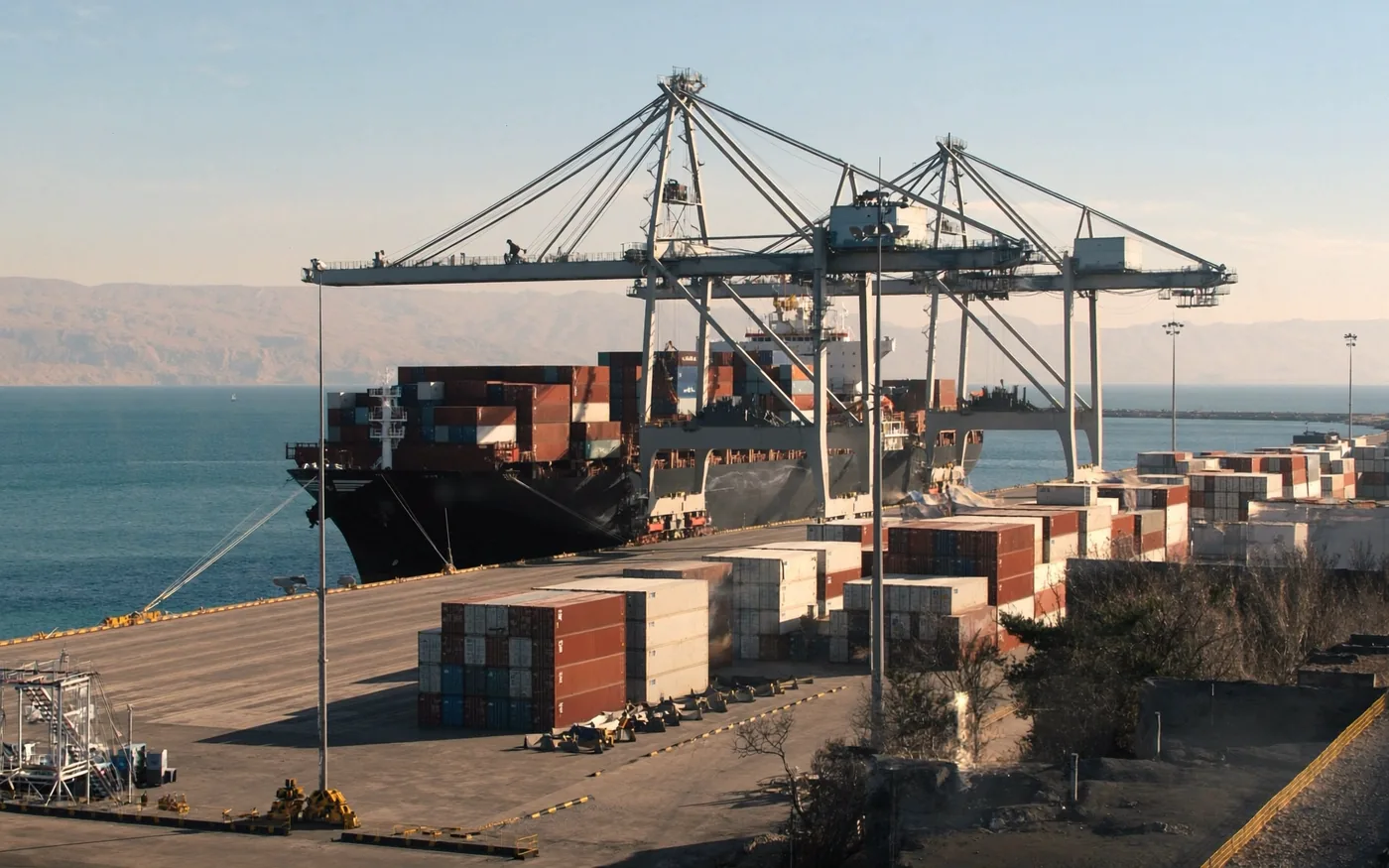
Aqaba, on the Red Sea, is Jordan's only seaport and the gateway for containerised and heavy export cargo leaving the country. MASA works it from an office in the city, staffed by our own operations people rather than by a subcontracted agent, so the terminal stage — receiving, gate-in and loading — is handled by the same company that prepared the documents in Amman. The file checked inland is the file that follows the cargo to the quay.
Air exports move through Queen Alia International Airport in Amman, where cargo is accepted, screened, built onto units and handed to the carrier. The airline decides acceptance, and it decides it on the cargo in front of it: the packing, the marking, the declared weights and, for anything regulated, the documentation that has to travel with the consignment. Whatever a carrier will not accept is stopped there, on the ground in Jordan, rather than discovered at the destination.
Road exports leave over Jordan's land crossings toward Saudi Arabia, the Gulf and other regional markets. A crossing is an authority's facility, run to its own procedures and its own hours, and neither MASA nor the carrier controls how a queue moves on any given day. What we control is that the truck arrives with a complete file, that the load is secured for the route it is taking, and that one person remains accountable for the movement from your gate onward.
Getting a Quote
What We Need From You to Quote an Export Accurately.
A quotation is only as good as what it was built from. A short list of details lets us price an export properly the first time, and missing any of them turns a quote into a range that moves once the cargo is finally measured. The list below is what we ask for, and it is the same list whatever the mode turns out to be.
Freight is priced on the cargo as it is packed, not on the product as it is sold. A carton of finished goods and the same goods on a pallet with a shrink wrap and a corner board are two different consignments to a carrier, because the pallet changes both the dimensions and the gross weight. Send the packed figures if you have them, and tell us if you do not — estimating them is part of the job, but the quote is firmer when they are real.
The destination address matters as much as the destination country, because inland delivery at the far end is priced from a place rather than from a border. The commodity matters because restrictions, permits and certificate requirements attach to the goods themselves. And the Incoterm matters because it tells us which legs you have already promised the buyer, which is the difference between quoting the shipment and quoting your obligation.
Frequently Asked Questions.
What documents do I need to export from Jordan?
Almost every export needs a commercial invoice, a packing list and the carrier's transport document, and many destinations also ask for a certificate of origin. Beyond that, the importing country and the commodity decide — health, phytosanitary, conformity or registration certificates, specific labelling, and sometimes certification and legalisation of the commercial documents. Tell us the destination and what the goods are, and we will confirm the set before you pack.
Who is responsible for import clearance in the buyer's country?
Under most terms the buyer, and that stays true even where you arranged the freight, because the trade term and the transport contract are two separate agreements. The buyer files in its own name and pays what is assessed there. Where you did quote a delivered price, MASA arranges the far-end work through the agent we appoint for that market, and that agent will normally need the buyer's registration details in the destination country before it can file anything. The authority's decisions remain outside anyone's control.
Do I need a certificate of origin to export from Jordan?
Apply in Jordan, before the cargo ships. Whether you need one at all is decided by the buyer's country and by the commodity; whether it saves the buyer any duty is decided by the trade agreement in force. Send us the destination and the goods, and we will tell you which of the two applies and in which form to apply, so the certificate is in hand while the goods are still in your yard.
Which Incoterm should a Jordanian exporter use?
Price it before you promise it. The term you quote decides how much of the destination-side cost sits inside your figure, which makes it a margin decision rather than a shipping one. DDP puts the most inside it, and it cannot be offered in every market, because some countries will not let a foreign seller act as importer of record. Send us the destination and the term you are considering, and we will price the legs it commits you to.
Can I export less than a full container from Jordan?
Yes. A part load travels as shared container space alongside other consignments, and it is rated on weight or on measurement, whichever produces the higher chargeable figure. Because it is consolidated at origin and separated at destination, it is handled more than a sealed container, so palletise and mark it clearly. The rated figure is taken from the packed cargo, which is why a firm quote follows the pallets rather than the purchase order.
Which ports and crossings does export cargo leave Jordan through?
Sea exports leave through Aqaba, Jordan's only seaport, where our own operations people work at the port rather than a subcontracted agent. Air exports go out through Queen Alia International Airport in Amman. Road exports leave over Jordan's land crossings toward Saudi Arabia, the Gulf and other regional markets. Which gateway applies follows the mode and the destination rather than the location of your factory, so the inland run to the gateway belongs in the quotation.
Can you arrange cargo insurance for an export shipment?
MASA can arrange cargo insurance through providers; we do not underwrite it ourselves. It is worth deciding early, because the Incoterm decides who carries the risk and from which point. Under CIF, for example, the seller buys the cover but the risk passed to the buyer at the port of shipment, and the term requires only the minimum level of cover — anything more has to be agreed in writing before you quote.
Can you export dangerous goods from Jordan?
Dangerous goods are handled via certified licensed partner agents — subject to MSDS review, carrier acceptance and route restrictions. In practice the safety data sheet is reviewed first, the carrier then decides whether it will accept the cargo, and the route may limit what can move. Send the MSDS with your enquiry before anything else is arranged, because acceptance is decided on the product rather than on the booking.
Start With the Cargo and the Destination
Tell Us What Is Shipping and Where It Is Going.
An enquiry that arrives with the details listed above comes back as a quotation. An enquiry without them comes back as a question first, which costs a round trip before anything is priced. Send them in one message and the reply carries the mode that fits, the documents the destination will ask for, and a straight answer on what belongs in your price and what belongs in the buyer's.